
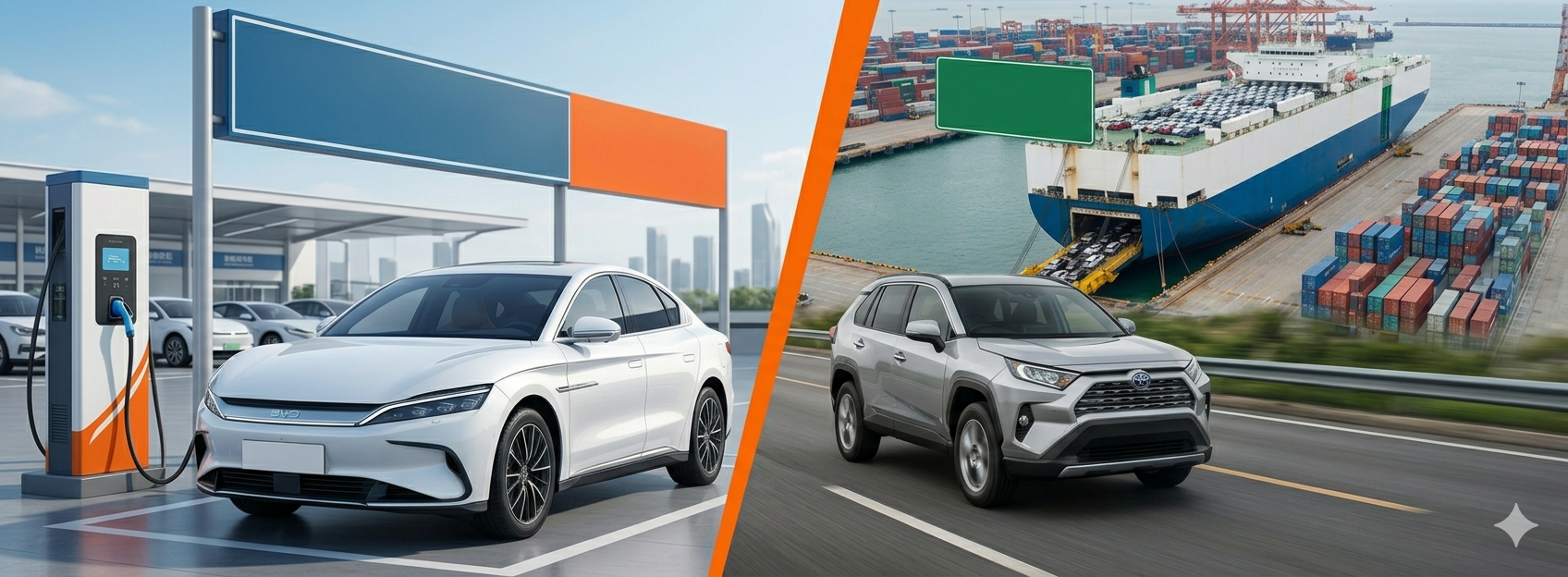
If you sell vehicles across different customer segments, you already know the frustrating truth: there isn’t a single “best” answer to gas vs hybrid vs EV.
A full-time rideshare driver cares about cost per mile and downtime. A typical household cares about reliability, convenience, and road-trip flexibility. And if you’re an importer or dealer, you also care about what you can verify (battery health, service history, documents) before you commit capital.
Below is a practical decision framework you can reuse with customers—plus a short checklist for what to verify on used-car listings.
Quick comparison matrix (what usually wins)
Decision factor | Gas (ICE) | Hybrid | Plug-in Hybrid (PHEV) | Electric (BEV/EV) |
|---|---|---|---|---|
Upfront price | Often lowest | +$0–$3k typical premium (varies) | Higher premium | Often highest |
Fuel/energy cost | Highest | Lower than gas | Low if charged regularly | Low if home-charged |
Downtime for “refuel” | Very low | Very low | Low–medium | Medium (planning required) |
Best fit for Uber driving | Sometimes | Often | Sometimes | Yes—if charging access is good |
Best fit for family use | Often | Often | Depends | Depends |
Definitions matter here. Consumer Reports’ hybrid vs plug-in hybrid vs EV buying guide (2026) is a helpful baseline if your customers mix up these categories.
Key Takeaway: For Uber drivers, the “best” choice is usually the one that minimizes total cost per mile and avoids surprise downtime. For everyday families, the best choice is usually the one that minimizes daily friction.
Step 1: Classify the driver profile (this decides 80% of the answer)
Before you compare vehicles, get the profile right.
Profile A: Full-time Uber/Lyft driver (high mileage)
Drives long shifts
Cares about operating cost per mile
Downtime equals lost income
Profile B: Everyday family household (mixed driving)
School runs, errands, weekend travel
Needs predictable convenience
Prioritizes reliability and service availability
Profile C: “In-between” (part-time rideshare + family)
Not enough miles to justify a complex switch
Still cares about fuel cost, but can’t accept extra hassle
If you’re advising customers, start with a simple question: “How many miles do you expect per day—and can you reliably charge at home?”
Step 2: Hybrid vs electric vs gas — compare the criteria that actually matter
1) Energy cost vs time cost (the Uber trade-off)
For rideshare drivers, the decision is rarely “EV is cheaper to run.” It’s more specific:
If the driver can charge at home overnight, EV economics are usually strong.
If the driver relies on public charging, the savings shrink—and the time cost grows.
This is why many rideshare discussions treat charging access as the real dividing line. Gridwise’s explainer on how Uber’s EV tiers work (and why charging downtime matters) makes this explicit: EV driving can work well when charging fits into natural downtime, but it becomes harder when charging is a daily scramble.
Practical rule of thumb (EV vs hybrid for rideshare):
Home charging available → EV or hybrid often makes sense.
No home charging → hybrid often becomes the safest “high-mileage” option.
2) Downtime risk (charging, repairs, and small failures)
Downtime is the hidden cost in rideshare.
Gas (ICE): fastest refueling, widespread service options.
Hybrid: similar refueling convenience to gas, with better city efficiency.
PHEV: can be great if plugged in. If not plugged in, you’re carrying extra weight/complexity without much benefit.
EV: least routine maintenance, but charging logistics become part of the job.
If a rideshare driver is constantly forced to break away from surge hours to hunt for chargers, the math can flip.
3) Driving pattern (city stop-and-go vs highway)
This is where hybrids shine.
City driving: hybrids typically do very well because regenerative braking and electric assist help in stop-and-go traffic.
Highway-heavy driving: hybrids still help, but the advantage can shrink. For long highway trips, convenience may matter more than efficiency.
For families who do frequent long road trips, gas or hybrid often feels easiest. For families who do mostly local miles and can charge at home, EV can be a great fit.
4) Complexity tolerance (especially for used vehicles)
This is underrated.
Gas vehicles are mechanically familiar and widely serviceable.
Hybrids add complexity, but they’re a mature category.
PHEVs combine two systems (gas + electric) and can be the most “complex” to own.
EVs simplify some components, but battery health and charging compatibility become core due-diligence items.
For used vehicles, the right choice is often the one where you can verify the condition with the least uncertainty.
Step 3: What we’d typically recommend (Uber vs family)
For Uber drivers: best car for an Uber driver — hybrid or electric depends on charging
Choose an EV when:
The driver can reliably charge overnight at home
Their market has dependable fast charging near common routes
They’re comfortable planning charging breaks
Choose a hybrid when:
They drive high mileage but don’t have reliable home charging
Downtime is extremely costly (they can’t afford 30–45 minute charging interruptions)
They want strong city MPG without changing habits
Where PHEVs fit for Uber: PHEVs can work when the driver will truly plug in often—otherwise they can behave like a pricey hybrid with extra complexity.
For everyday families: gas vs hybrid for a family car is often the low-friction choice
One common question is EV charging vs gas refueling road trip time. If your customers value “5 minutes and back on the highway,” gas (and many hybrids) still wins on convenience. EV road trips are workable, but they require charging-stop planning and longer breaks—something many busy families simply don’t want to think about.
Your note (“typical household should consider gasoline”) is often true in practice because families usually value:
easy refueling everywhere
predictable long-trip rhythm
broad service availability
That said, hybrids are often the “best of both worlds” family choice when:
the household does a lot of city driving
they want fuel savings without changing routines
And EVs are a strong family choice when:
home charging is available
the family mostly drives locally
road trips are occasional (and they’re willing to plan charging stops)
Step 4: If you’re a dealer/importer, here’s the due-diligence checklist that matters
This is the part many generic car-buying articles skip.
For used gas cars (ICE)
Service history consistency
Evidence of accident repair and corrosion
Emissions-related issues (market-dependent)
For used hybrids
Confirm hybrid system health (where available)
Look for signs of neglected maintenance
Make sure the customer understands that hybrid savings are best in stop-and-go use
For used EVs
Battery health documentation (capacity/health report if possible)
Charging compatibility for the target market
Any visible evidence of poor charging habits or storage issues (when disclosed)
If you’re sourcing vehicles internationally, add a compliance check early.
⚠️ Warning: Importing vehicles into the U.S. has strict requirements. NHTSA states that “a motor vehicle that is at least 25 years old can be lawfully imported into the U.S. without regard to whether it complies with all applicable FMVSS,” while newer nonconforming vehicles generally cannot be permanently imported unless specific eligibility and modification pathways apply (see NHTSA’s Importation and Certification FAQs). EPA also notes that the Clean Air Act prohibits importing vehicles/engines that don’t conform to emissions standards, with limited certification/exemption pathways (see EPA guidance on importing vehicles and engines).
Where Global Auto Export fits (without the hype)
If you’re building inventory for price-sensitive or import-restricted markets, the most important thing isn’t the powertrain label—it’s whether you can verify condition and documentation before you ship.
That’s why platforms like Global Auto Export focus on browseable listings and clear vehicle details. If you want to explore what’s available across segments, you can start by browsing current used-car inventory or checking the site’s New Energy Vehicles (NEVs) listings as a starting point.
FAQ
Is a hybrid always better than a gas car for Uber?
Not always, but it often is for city-heavy rideshare. If a customer is asking about the best car for Uber driver hybrid or electric, the right answer usually depends on charging access and how much downtime they can tolerate.
Is an EV always the cheapest option for rideshare driving?
It depends on charging access. The real decision is often EV vs hybrid for rideshare: home charging makes EVs compelling, while public-charging-only drivers often do better with a hybrid.
For families, when does an EV make the most sense?
When there’s reliable home charging and most driving is local. If you’re advising a household and they’re deciding gas vs hybrid for family car, hybrids are often the safest “upgrade” because they cut fuel use without changing habits.
Next steps (soft CTA)
If you tell us your target market and customer mix (rideshare-heavy vs family-heavy), we can help you build a practical shortlist—ICE, hybrid, and NEV options—plus a documentation checklist you can use before committing to a shipment.